3 min read
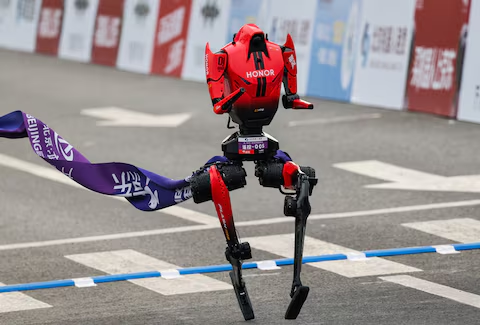
A Chinese humanoid robot has stunned the technology world after completing a 100-meter sprint in just 9.39 seconds, a time faster than Usain Bolt’s long-standing human world record of 9.58 seconds.
The record-breaking run took place on August 22, 2026, during the second World Humanoid Robot Games at Beijing’s National Speed Skating Oval, also known as the “Ice Ribbon.”
Tiangong Ultra Takes the Lead
The robot, called Tiangong Ultra, was developed by the Beijing Humanoid Robot Innovation Center. During a preliminary 100-meter race, Tiangong Ultra initially trailed another Chinese humanoid robot called Lightning before overtaking it near the finish line.
Tiangong Ultra crossed the line in 9.39 seconds, while Lightning finished in 9.47 seconds. For comparison, legendary Jamaican sprinter Usain Bolt set the men’s human 100-meter world record of 9.58 seconds at the 2009 World Athletics Championships in Berlin.
The robot’s achievement does not replace Bolt’s official athletics world record, since human and robot competitions are separate categories. However, it demonstrates just how rapidly humanoid robotics technology is advancing.
A Huge Improvement in Just One Year
Perhaps even more impressive is how quickly these machines are getting faster.
At the inaugural World Humanoid Robot Games, Tiangong Ultra completed the same 100-meter distance in 21.50 seconds. Cutting that time to 9.39 seconds represents a dramatic improvement in robotic movement, balance, mechanical design and control systems.
High-speed running remains extremely challenging for humanoid robots. Machines must continuously calculate balance, foot placement and body movement while responding to forces generated at high speeds.
The latest competition showed that robots can now achieve remarkable straight-line speed, although they still have limitations. Both leading robots reportedly struggled to slow down safely after finishing, highlighting the gap between raw speed and the agility and control humans naturally possess.
More Than 2,000 Robots Compete in Beijing
The 2026 World Humanoid Robot Games have grown significantly compared with their first edition.
According to organizers, the event features 2,056 humanoid robots from 666 teams representing 16 countries. Robots are competing across dozens of challenges designed to test athletic performance and practical abilities.
Competitions include running, football, table tennis, weightlifting and tug-of-war. Other challenges focus on tasks that could eventually have real-world applications, including logistics, hospitality, household services, emergency response and electric-vehicle charging.
These practical challenges may ultimately be more important than breaking sporting records. For humanoid robots to work successfully in factories, warehouses, homes or public spaces, they must be able to navigate unpredictable environments and manipulate everyday objects reliably.
China Pushes Ahead in Humanoid Robotics
The Beijing event also highlights China’s growing investment in humanoid robotics and artificial intelligence.
Chinese technology companies are racing to develop robots capable of working alongside humans in manufacturing and other industries. The sector has attracted significant investment as companies explore potential applications ranging from industrial automation to household assistance.
The progress demonstrated in Beijing suggests humanoid robots are moving beyond slow experimental machines toward systems capable of increasingly complex physical tasks.
Still, running faster than a human does not mean humanoid robots are ready to replace people. Engineers continue to face major challenges involving battery life, reliability, dexterity, autonomous decision-making and safe operation around humans.
A Glimpse Into the Future
Tiangong Ultra’s 9.39-second sprint is nevertheless an eye-catching milestone.
Only a few years ago, humanoid robots often struggled simply to walk smoothly without losing balance. Today, machines are sprinting at speeds comparable to elite human athletes while simultaneously being developed for factories, warehouses and service industries.
The real race, therefore, may not be between robots and Olympic athletes.
It is the race to determine how quickly humanoid robots can move from impressive demonstrations to useful machines capable of working effectively in the real world.
